
From Past to Future
One technology. Three perspectives.
Each feature follows a single technology development through its Past, Present and Future, so you can see how it began, how it is used today and where researchers think it could lead. New features are added from a reviewed list. The newest is shown first, and earlier features stay in the archive below.
How to read the labels
- Established fact something documented in the sources listed.
- Current use how the technology is used or understood now.
- Research in progress work that is still being done. It is not a finished product.
- Forecast, not certain a plan, target or prediction. It may not happen, or may happen differently.
This week’s technology
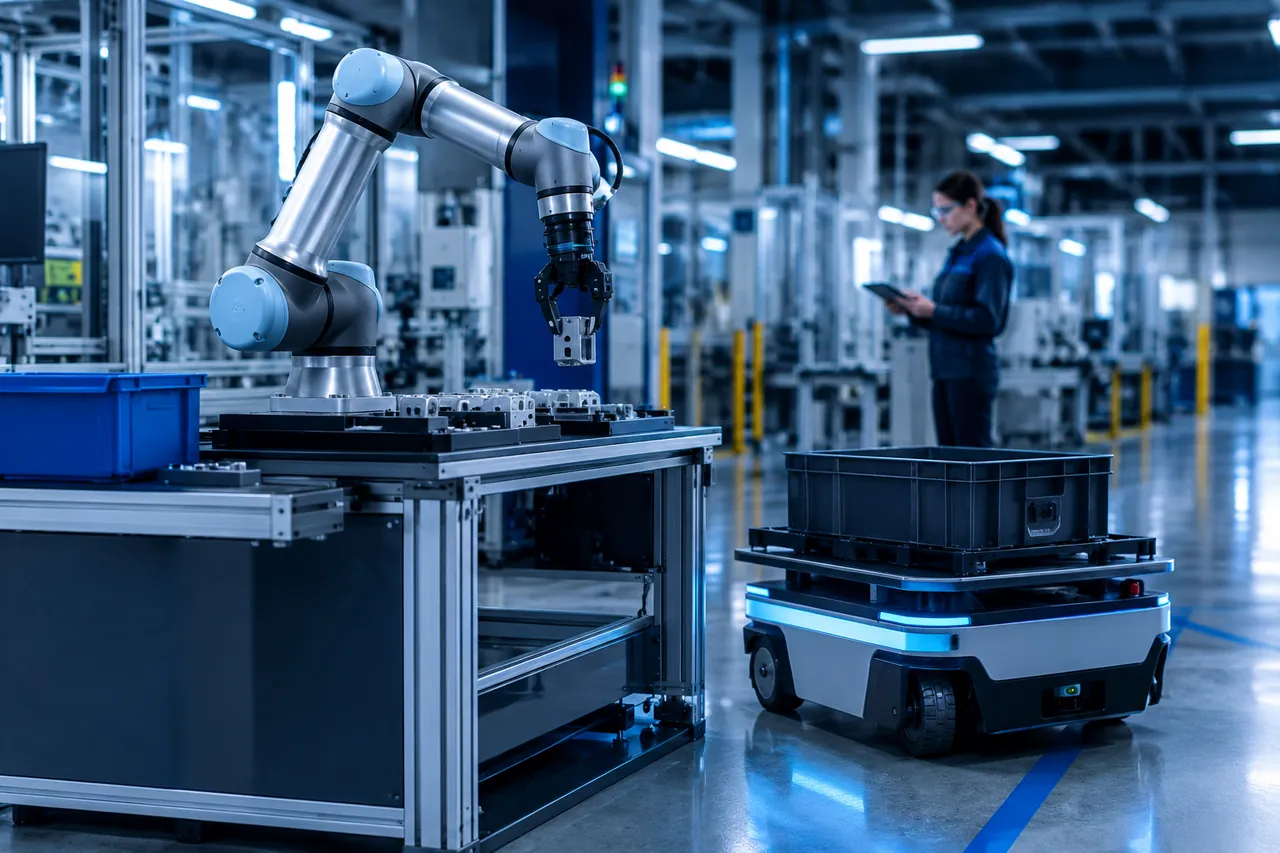
Industrial robots: from the first Unimate to today's factory floors
A robot arm that helped a die-casting machine in 1961 is a good starting point for understanding why factories use robots now, and what researchers hope robots will do next.
-
Past
How it started
Industrial robots began as programmable arms that could repeat a handling task on a production line.
- 1954Established fact George Devol applied for a patent for a device he called the "Programmed Article Transfer". He later formed Unimation with Joseph Engelberger. [1]
- 1961Established fact The first Unimate was installed at a General Motors plant in Trenton, New Jersey, where it assisted a hot die-casting machine. It was hydraulically powered. IEEE Spectrum gives this account; other sources give slightly different dates for the prototype and the installation. [1]
-
Present
How it is used today
Industrial robots are now a large, established part of manufacturing.
- 2024Current use The International Federation of Robotics (IFR) reports about 542,000 industrial robots installed worldwide in 2024, and about 4.66 million in operation, up 9% on the year before. These are supplier-reported figures for industrial robots only, not service or medical robots. [2]
-
Future
What researchers and industry are exploring
Nobody can say for certain what comes next. The examples below describe work in progress and the IFR's own expectations.
- In developmentResearch in progress The IFR says humanoid robots are moving from development towards early deployment, with warehousing and manufacturing uses emerging. To succeed, it says they must match traditional automation on cycle time, energy use and maintenance cost, and meet industrial safety standards. [3]
- PossibilityForecast, not certain Whether humanoids become common on factory floors is not settled. The IFR is an industry body, so this is its view and expectation, not an independent finding. [3]
Sources
- George Devol: A Life Devoted to Invention, and Robots. IEEE Spectrum (Bob Malone). 26 September 2011. Supports the 1954 patent application, the 1961 General Motors installation at Trenton, New Jersey, its hydraulic power, and the formation of Unimation. Checked against the page on 29 October 2026. It is one account; other sources differ on some dates.
- World Robotics 2025 report: global robot demand in factories doubles over 10 years. International Federation of Robotics (press release). 25 September 2025. Supports the 2024 installations (about 542,000) and operational stock (about 4.66 million, +9%). The figures were confirmed through search results that summarise this release; the IFR executive summary cited on our Robotics page could not be read as text during this check.
- Top 5 Global Robotics Trends 2026. International Federation of Robotics (press release). 8 January 2026. Supports the statements about humanoid robots and the conditions the IFR says they must meet. Checked against the page on 29 October 2026. The IFR is an industry body.
Archive
Earlier features will appear here as newer ones are published. Nothing is ever removed.