
Tech Meets Nature
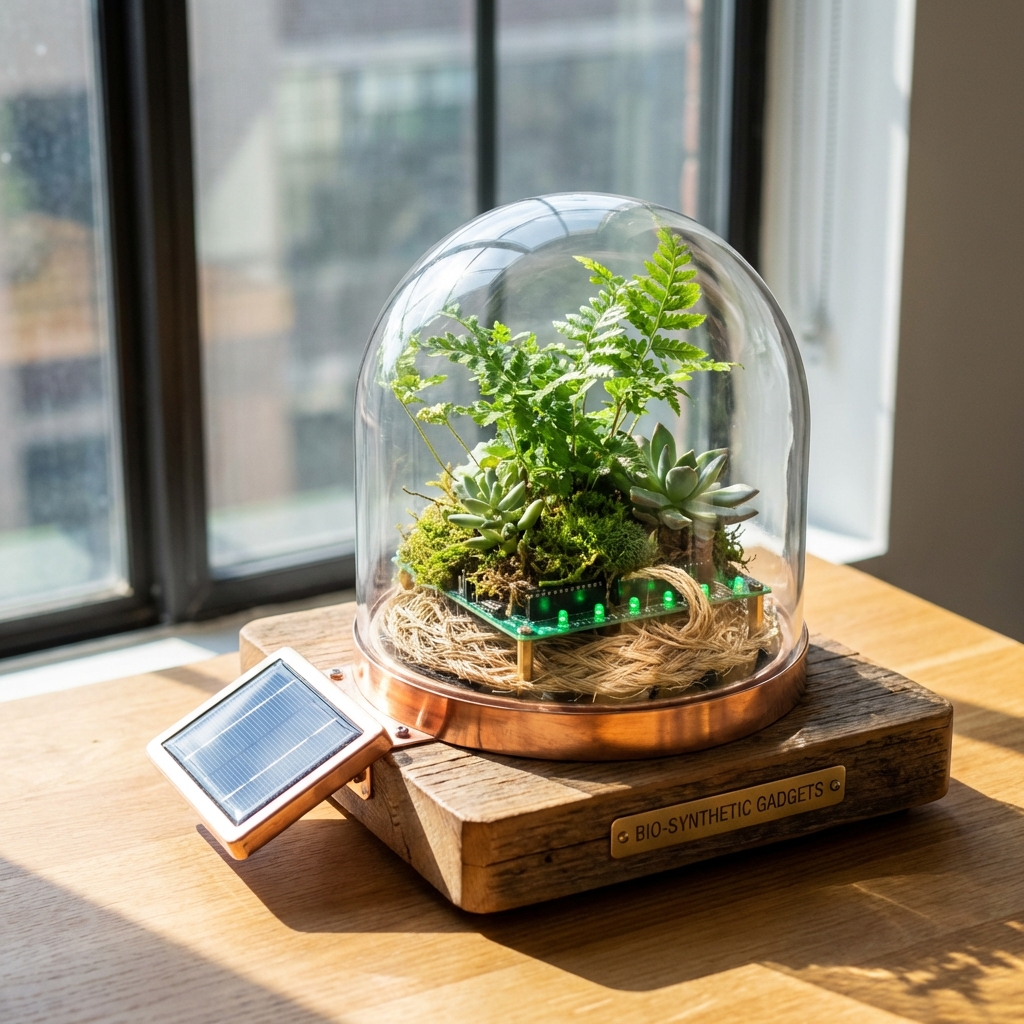
In a world grappling with climate change, many people are asking whether technology can be made to work with the natural world instead of against it. One label for that hope is solarpunk: a creative and cultural movement that imagines a future in which technology and nature coexist. It is a vision, not an engineering standard, so it helps to separate the vision from what researchers have actually demonstrated. This article looks at two ideas often linked to it, electronics that break down after use and devices that run on energy from their surroundings. It asks what the evidence supports and where the limits are.
What solarpunk is, and is not
Writer Adam Flynn set out the idea in a short 2014 essay for Project Hieroglyph, describing solarpunk as a futurism built on “ingenuity, generativity, independence, and community”. He pairs advanced technology with simple, elegant interfaces, and mentions examples such as rooftop solar and grid resilience.[1] Solarpunk is therefore a way of imagining and discussing technology, not a product category. A device is not solarpunk because it looks green. What matters is what it does to energy use, waste and the environment, and that can be checked.
The problem: a growing pile of e-waste
The scale of the problem explains the interest in greener electronics. The UN-backed Global E-waste Monitor 2024 reports that 62 million tonnes of electronic waste were generated worldwide in 2022, up 82% from 2010. Only 22.3% of that was documented as formally collected and recycled in an environmentally sound way. The report projects generation of 82 million tonnes by 2030, with the documented recycling rate falling to about 20%.[2] It also values the metals in 2022’s e-waste at US$91 billion, so wasted electronics are both an environmental and an economic loss.[2] Any technology that claims to help should be measured against these figures.
Transient electronics: devices designed to disappear
One promising area is transient electronics, devices designed to dissolve or degrade after their useful life. In 2012 a team led by John Rogers and Fiorenzo Omenetto reported a form of silicon electronics built from magnesium conductors, magnesium oxide and silicon dioxide insulators, thin silicon and a silk support. Silk is water soluble and can be broken down by enzymes, and the silk and oxide layers set how quickly the device dissolves, from days to months. In animal tests, an implanted heater disappeared within about two weeks.[3]
That is real progress, but the demonstrations were medical: implants that need not be removed by surgery. Extending the idea to the phones, laptops and appliances that dominate e-waste is a much harder problem, because those products contain many materials and parts. Our reading is that transient electronics are best seen as a tool for specific uses, such as temporary implants or short-lived environmental sensors, not as a cure for e-waste. Claims that they could “eliminate” e-waste go beyond what the evidence supports. Biodegradable also does not automatically mean low impact: the energy and materials used to make a device still count.
Energy harvesting: powering small devices from the surroundings
Energy harvesting collects small amounts of energy from light, movement or radio waves. The numbers show where it works. A 2020 review of indoor solar cells notes that indoor light is 10 to 1,000 times weaker than sunlight, and gives measured outputs of around 96 microwatts per square centimetre under a 200-lux LED. The review notes that indoor light varies with time and with the type of source. The authors say that the wireless sensors, actuators and wearables of the Internet of Things need power in the microwatt range and operate indoors, and one of their examples, a credit-card-sized cell, harvested about 4 milliwatts under brighter 1,000-lux lighting.[4]
That is enough for a low-power sensor that reports readings occasionally, which makes harvesting a good match for the sensors described in our Internet of Things guide, since it can reduce battery changes. The sources do not show devices such as phones charging themselves from ambient light, so claims of a “grid-independent future” for everyday devices are not supported. Harvesting is a useful supplement for small devices, not a replacement for the grid.
Judging green technology claims
Three questions help. First, what is the measured effect: less waste, less energy, longer life? Second, what is the scale: a laboratory demonstration, a niche product or a mass-market change? Third, what is the trade-off: materials, cost, reliability and repairability all matter. Our Technology Comparisons and Reflection page sets out these kinds of question for any technology, and Emerging Technologies explains why early results are often uncertain.
The honest summary is that technology and nature can be brought closer together, but through specific, measurable steps: designing devices that last, are repairable and can be recycled, using dissolvable electronics where disappearing is the point, and powering small sensors from ambient energy. The vision is inspiring; the evidence shows where it already works and how far there is still to go.
Green technology claims are strongest when they come with measurements.
Sources
- Adam Flynn. Solarpunk: Notes toward a manifesto. Project Hieroglyph, 4 September 2014. Supports: the quoted values and the pairing of technology with simple interfaces. An essay, not research.
- UNITAR and ITU. Global e-Waste Monitor 2024. Released 20 March 2024. Supports: the 62 million tonne, 82%, 22.3%, 2030 projection and US$91 billion figures.
- Hwang and others. A physically transient form of silicon electronics. Science 337, 1640–1644, 28 September 2012 (author manuscript). Supports: the materials, the silk-controlled dissolution and the animal demonstration. The details were confirmed from search summaries of the paper and its coverage; the full text was not read. The demonstrations were medical.
- Biswas and Kim. Solar Cells for Indoor Applications: Progress and Development. Polymers 12(6), 1338, 2020. Supports: the indoor-light comparison, the microwatt figures and the IoT power range.